

Business continuity has become a major concern for companies worldwide. Recent events, such as natural disasters, cyberattacks, and the global pandemic, have highlighted the importance of business continuity planning to ensure the resilience of businesses. However, implementing a business continuity program (BCP) is not enough to guarantee its success. Companies must understand the phases of a BCP lifecycle and the key factors that contribute to its success.
In this article, we provide a brief overview of the various phases of a BCP lifecycle, as well as the most important success factors that will help businesses ensure their resilience in the face of unforeseen events.
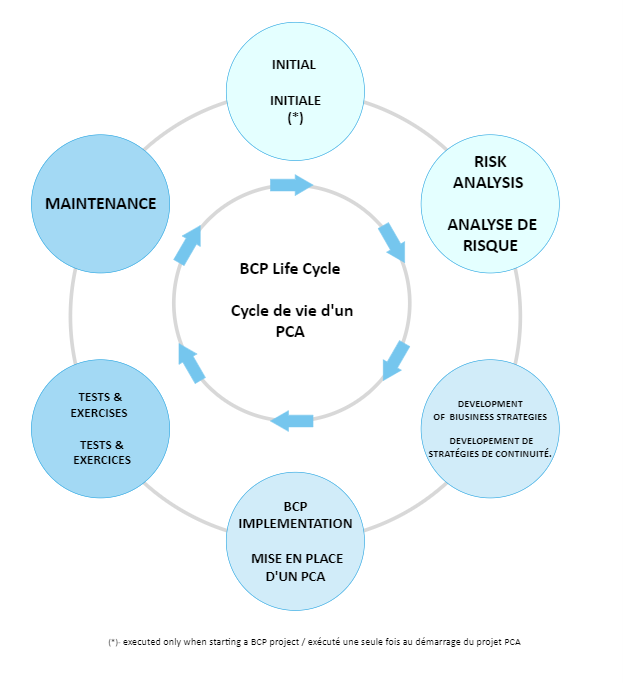
• The initial phase: This first phase consist of:
- Determining the relevance and urgency of implementing a BCP within the company.
- Obtaining management support.
- Appointing a business continuity team.
- Defining the objectives of such a project.
• The risk analysis phase: A comprehensive risk analysis will allow:
- The Identification of the risks the company is exposed.
- Determination of the priorities in terms of business continuity.
- Identification of potential crisis scenarios and their impacts, which will allow appropriate continuity strategies in the next phase.
- Development of a Business Impact Analysis (BIA) document which will be the culmination of this risk analysis phase.
• The business continuity strategy development phase: This is an important phase in the lifecycle, as it is during this phase that business continuity strategies are defined to address the risks identified during the risk analysis.
• The implementation phase of the business continuity program: During this phase, companies must establish the structures, processes, procedures, and resources needed to prepare the business to handle crisis situations and maintain critical operations in the event of a major disruption.
• Training and awareness: This phase aims to provide training and raise awareness among the company’s personnel on business continuity procedures, policies, and practices to better prepare them to deal with emergency situations during a major incident.
• Testing and exercises phase: Testing and exercises are essential for ensuring the effectiveness and relevance of the BCP. They allow:
- The practical application of business continuity processes and procedures.
- Identification of gaps and weaknesses and addressing them before a real crisis occurs.
- Employees to become familiar with continuity measures, which strengthens their preparedness and confidence in case of an emergency.
• The maintenance phase: Maintaining a BCP is crucial for ensuring its longevity and effectiveness. It involves the regular review and updating of the plan to ensure that procedures are still adapted to the risks and needs of the business.
Throughout these different phases, some factors contribute more than others to the success of the business continuity program, including:
- Commitment from top management: Effective awareness among top executives of the need to implement a business continuity program is crucial for the success of such a project. Top management will allocate an appropriate budget to the project and ensure that the necessary skills and resources are available for the effective implementation of the project.
- An effective business continuity team: Business continuity team members should be selected based on several criteria, including: competence, analytical ability, communication, collaboration, knowledge of the company, ability to work as a team, adaptability, and commitment to the project’s success.
- A comprehensive risk analysis: This risk analysis should examine all possible risks that could affect an organization.
- Appropriate training and awareness activities: This will ensure that all team members understand and adhere to the business continuity strategy and plans.
- Quality and frequency of tests and exercises: Proper preparation of test and exercise scenarios, appropriate participant selection, and successful execution of this step will significantly increase the effectiveness of the BCP when activated during a major incident.
- Regular maintenance: This activity is carried out throughout the year, and regular monitoring of the company’s environment should be established to update and improve our plans.
- Good documentation: Comprehensive and up-to-date documentation is essential to ensure that all staff and stakeholders understand roles and responsibilities, emergency procedures, and business continuity plans. In a crisis, clear and up-to-date documentation can help reduce downtime and minimize losses by facilitating quick decision-making and the implementation of appropriate emergency plans.
Despite the unique characteristics of each company, other success factors may be identified. However, the seven key factors mentioned in the text provide a solid foundation for ensuring business resilience. It is important to note that implementing a BCP does not guarantee flawless business continuity. Regular assessment of the program, adjusting it accordingly, and ensuring it constantly adapts to changes in the company’s environment is crucial.